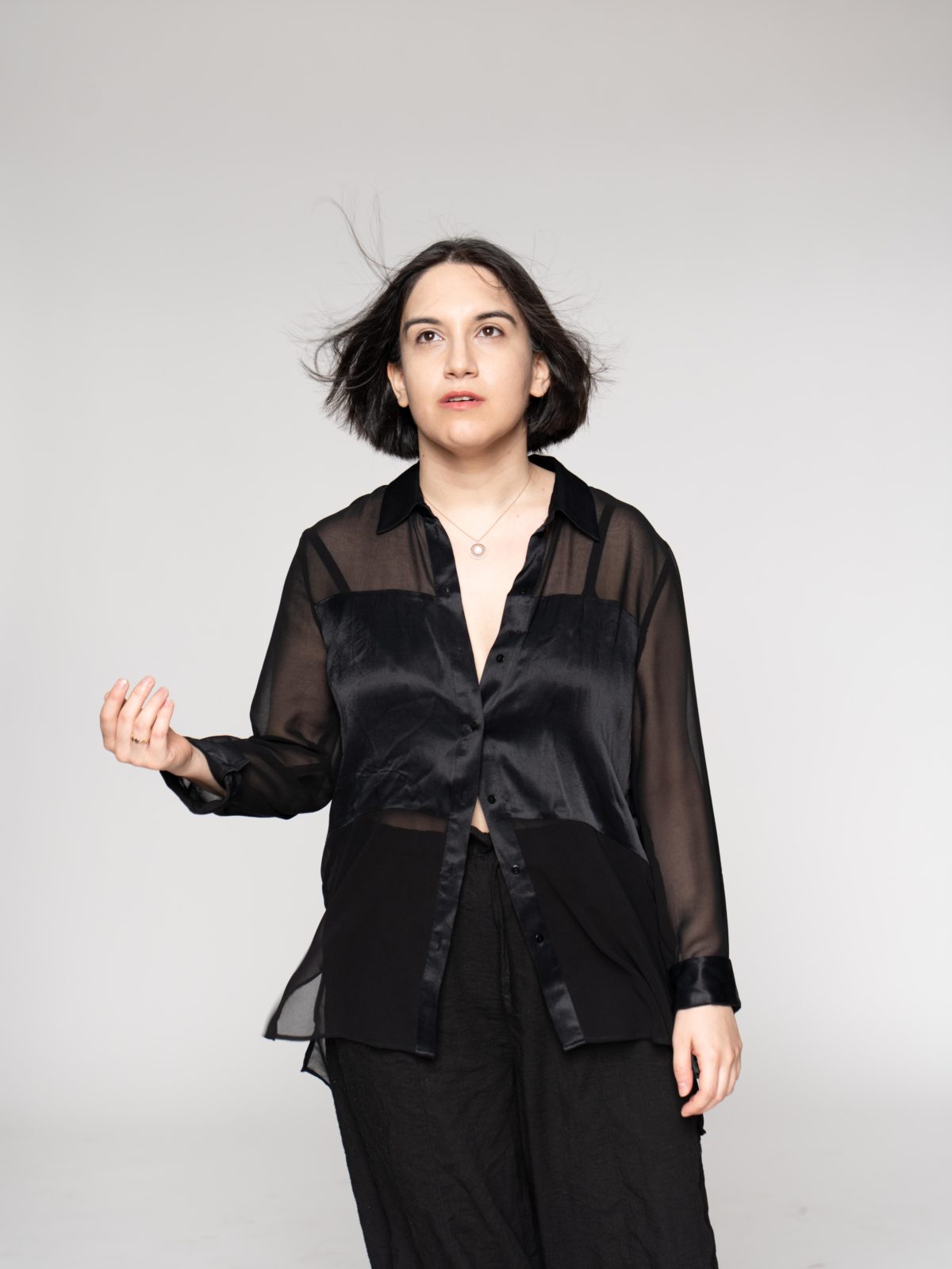
Luna Vintner stands against a light gray background wearing a sheer black blouse and black pants, looking slightly upward with one hand raised. Her short dark hair slightly windblown.
Luna Vintner is a New York–based multidisciplinary artist working across music, movement, and acting. She is a multi-instrumentalist, composer, and improviser whose work explores the relationship between sound, embodiment, and accessibility.
Originally from Turkey, Luna moved to the United States to pursue drama training after completing her bachelor’s degree in psychology with a minor in music. She composes original music for short films and performance works, and she is also an independent singer-songwriter, creating intimate interdisciplinary projects that blend music, storytelling, and physical expression.
As a legally blind artist, her practice aims to create inclusive improvisational spaces where music and movement meet as equal creative partners, dissolving traditional hierarchies between dancer and musician. Her work includes original music releases, film composition, and the creation of listening-based movement practices such as Moving In and Out of Tune, designed in collaboration with blind and visually impaired movers.
About This Workshop Series:
Moving In and Out of Tune is a listening-based movement creation practice developed by Luna Vintner. The workshop centers improvisational exchange between live music and movers, inviting participants to create sound and movement together in real time.
Through guided prompts and theme-based improvisational scores, dancers explore music not as accompaniment, but as an ever-changing landscape for embodied response. The practice supports the discovery of surprising movement vocabulary through deep listening, intuition, and presence.
Offered virtually in collaboration with Dark Room Ballet, this series is designed for blind and visually impaired movers, emphasizing accessibility, non-visual connection, and shared artistic authorship between musician and dancer. Instrumentalists are welcome to participate, joining the workshop as creative collaborators in this live improvisational space.
Workshop Dates and Details:
Moving In and Out of Tune: a listening-based movement creation workshop series with live music performed by acclaimed musician, actor, and dancer, Luna Vintner. (Listen to Luna on Spotify!)
Workshops will be offered virtually on Zoom.
Each workshop is two hours long:
Workshop #1: Sunday, August 2, 2026 from 12 PM to 2 PM (Eastern/New York Time)
Workshop #2: Sunday, August 9, 2026 from 12 PM to 2 PM (Eastern/New York Time)
Workshop #3: Sunday, August 16, 2026 from 12 PM to 2 PM (Eastern/New York Time)
Workshop #4: Sunday, August 23, 2026 from 12 PM to 2 PM (Eastern/New York Time)
To register for this workshop series, send an email to [email protected] with the subject line Moving In and Out of Tune
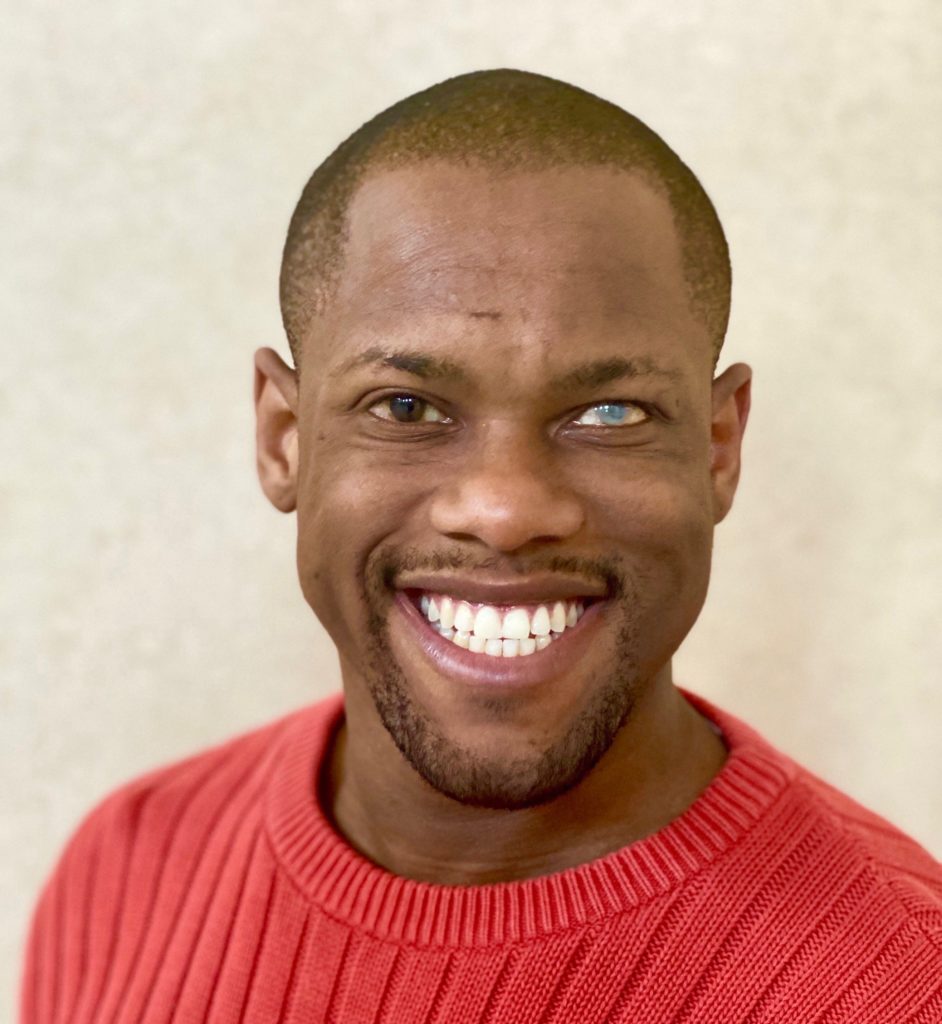
A headshot photo of Davian “DJ” Robinson. He smiles widely, and is wearing a red sweater.
About Davian “DJ” Robinson:
Davian “DJ” Robinson is a passionate and boundary-breaking visually impaired dancer, choreographer, and performer. Drawing from his lived experience and athletic movement style, he creates choreography that is both physically powerful and emotionally resonant. His work blends dynamic storytelling with raw embodiment, inviting audiences into a world where rhythm, resilience, and adaptability redefine how we move and connect. Through both performance and education, Davian challenges conventions and opens new possibilities for inclusive expression in the arts.
About This Intensive Workshop Series:
Sensory Beyond Sight cultivates movement using breath, touch, spatial hearing, weight, and proprioception rather than sight. Developed by visually‑impaired choreographer DJ Robinson, the practice empowers participants to:
• Discover liberating, imaginative movement without visual imitation. • Deepen body awareness in time and space. • Build trusting partnerships that translate verbal cues into motion.
Tactile & Creative Supplies:
DJ often designs choreography using a tactile drafting board/felt board.
Magnetic or Velcro pieces represent dancers and pathways, allowing him to map formations by touch and communicate spatial ideas clearly.
This reminder models how tactile tools can replace sight‑based diagrams.
What follows are shopping links for the different equipment options that you can choose to use during the workshop series and continuing on in your own choreographic practice:
Wikki Stix Neon Pak (Amazon link) Reusable, bendable wax-coated yarn sticks for creative tactile art and sensory play. Great for children, educational projects, and travel activities.
ANLIOTE 12″×9″ Dry-Erase Whiteboard (Amazon link) Handheld double-sided dry erase board, perfect for quick notes, learning, or drawing. Includes markers and erasers.
DRAFTSMAN Tactile Drawing Board(APH link) A specialized tactile drawing board with stylus and film sheets, allowing blind or visually impaired users to create raised-line graphics. Durable and portable, offered by the American Printing House for the Blind.
Picture Maker Wheatley Tactile Diagramming Kit (APH link) A diagramming kit with a felt board and velcro-backed pieces, allowing for building tactile diagrams and graphics for orientation, mobility, or educational work.
Workshop Dates and Details:
This workshop series is cumulative, and each of the four workshops builds on the skills developed the week before.
All workshops start at 4 pm (Eastern Time), and are 90 minutes long.
Friday, May 15, 2026
Friday August 7, 2026
Friday September 18, 2026
Friday October 9, 2026
Friday November 6, 2026
Friday December 4, 2026
To register for this transformative workshop series, send an email to [email protected]with the subject line Sensory Beyond Sight.
Tell Your Story: An Introduction to Narrative Podcasting with H. May
Workshops will be held via Zoom on Tuesdays from 3-5 PM Eastern (New York) Time, June 16, June 30, July 14, July 28, August 11, and August 25.
Student Cap: 10
This six-week course is designed to introduce blind and low-vision artists to sound design, storytelling techniques, recording / editing processes and tools, and organizational approaches useful in the production of narrative podcasts. This workshop is designed to take participants through the process of writing a short story, enhancing it through sound, and sharing it with others. H. May is a blindish theatre artist trained in a multitude of techniques for generating performance material from personal experience. As a theatre director married to a sound designer and podcast producer, their work consistently benefits from the incorporation of sound and audio description as an integral part of storytelling. This class is designed to meld theatre and digital sound recording techniques in the creation of imaginative narrative podcasts.
While primarily a live theatre artist, H. increasingly finds themself turning to sound art as a means of storytelling that scratches their sensory desires and their exploratory impulses. As a blindish artist largely isolated from working with other blind and low-vision artists, H. looks forward to facilitating this workshop for the opportunity to learn how to make the art we hope to hear in the world alongside other members of the blind community.
Schedule: Six two-hour sessions, every 2 weeks starting June 16.
June 16, Week One – Introduction to Podcasting and Preparing the Voice
Topics include: A brief overview of podcasting (what it is, why it is popular); discussion of podcasts folks are listening to and why; introductory vocal exercises
Homework: Listening to sample podcasts, bringing in an example of something they like, and telling the story of an object that means something to them
June 30, Week Two – Storytelling (what makes for good storytelling in terms of structure)
Topics include: Discussion of sample podcasts from homework as regards how they tell stories
Homework: Reading part of the script analysis text Backwards and Forwards, analyzing a fairy tale for what makes it compelling, reworking object story to implement storytelling techniques
July 14, Week Three – The nature of sound and recording sound
Topics include: techniques for recording sound on cell phones, overview of cheap recording devices, demonstrations of sound recordings
Homework: Record something familiar that is instantly recognizable and record something familiar that is hard to recognize
July 28, Week Four – Combining story and sound through editing
Topics include: listening to examples of sounds used to heighten storytelling. These sounds include multiple voices for characters, underscoring with music, copyright issues, other sound effects and sound effect libraries
Homework: Record your object story but bring sound into it.
August 11, Week Five – Continuation of Week Four, working with students on their projects
Homework: Continuing Editing Object Story
August 25, Week Six – Organizing / Planning for a longer series and publishing your podcast
Topics include: Learning how to map out a season, assessing sustainable timelines, introduction to podcasting platforms
About H
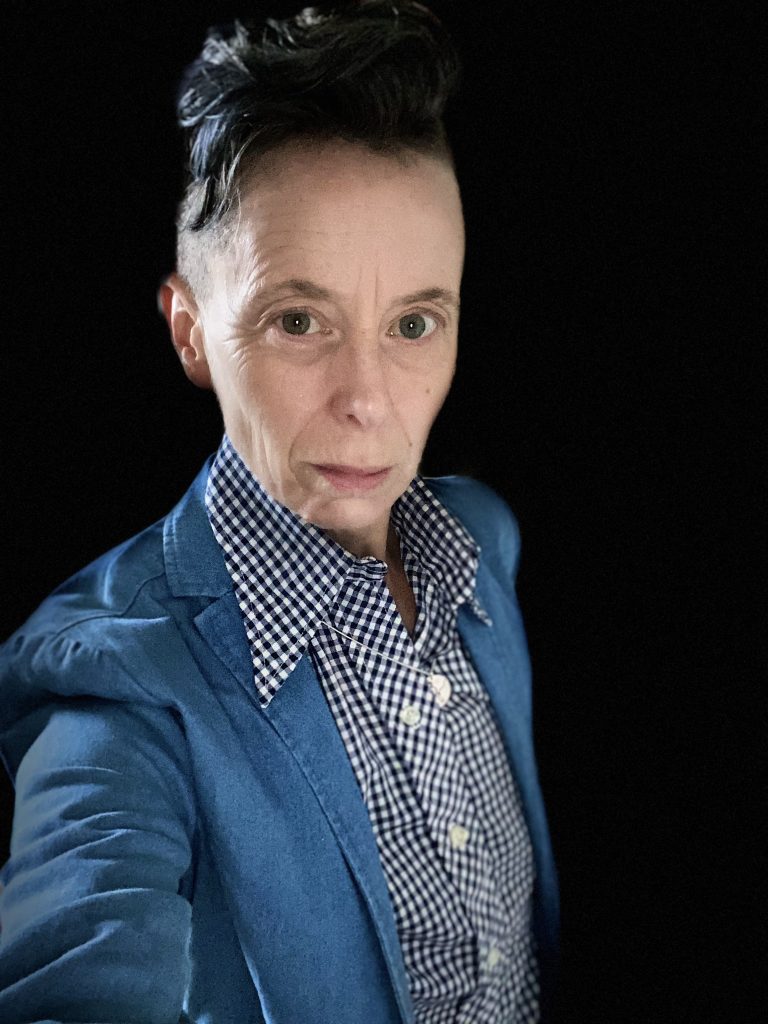
H. May (they / them) is a blindish* Professor of Theatre at Hobart and William Smith who loves theatre for its adventures. H has reveled in a career that has allowed them the grace and flexibility to be always in transition, transforming their artistry and scholarship to suit the needs of the moment. And their current moment is building creative spaces and collaborations that embrace the aesthetic possibilities of multi-sensory art. H. is fortunate to have a spouse who is a professional sound designer and podcast producer. Together they have been integrating sound into theatre productions for three decades, and have broadened this work into film and audio production over the past six years. H.’s autoethnographic film “Awaiting Tiresias” explores the shifting emotional landscape of the early stages of a blindness diagnosis. The film is fully audio described. “Awaiting Tiresias” was screened at the Great Lakes International Film Festival, the Together! Disability Film Festival, was a semi-finalist for the Blow-Up Arthouse Filmfest in Chicago, and won Disability Awareness and Contemporary Issues / Raising Awareness Awards of Merit from the IndieFEST Film Awards. They have also performed a livestream version of “Awaiting Tiresias” at multiple conferences, including the Hong Kong Academy of Performing Arts Digital Humanities Conference and the Digital Research in the Arts and Humanities Conference (UK).
While H.’s work in the theatre has primarily been as a director, they have enjoyed learning among fellow professional artists at performance and devising workshops and residencies with Indy Convergence (2019), La MaMa Umbria International Directors Symposium (2014, 2017), Dell’Arte International Summer Intensive (2015), Pig Iron Theatre (2018), and Directors Labs North (2015) and West (2014, 2017).
As an artist who has gone blind in the late stage of their career in a rural community with few other blind people (never mind in the theatre), H. has largely had to teach themself new approaches to theatre. They were thrilled to discover Dark Room Ballet a few years ago, the first blind community they’d experienced. Unsurprisingly, it was also the first audio description training they received that actually treated blind audiences as full collaborators and artists. They are honored and excited to be among the rotating faculty for Dark Room Ballet, where they can continue to learn in community with fellow blind and low-vision artists.
* While they could use the term “legally blind,” H. fights against medicalized gatekeeping and feels that “blindish” is a more accurate description of the way their sight fluctuates depending upon the circumstances.
To Register for this course please email [email protected] to receive the intake questions and instructions for scheduling an interview with H.
Beginning May 30 Five Courses on Saturdays from 4-6pm
Registration is now open! To register for any of these tuition-free workshops, please send an email to [email protected]
This series of five online workshops covers a variety of topics related to audio description for dance and are designed not only as professional development for audio describers, but also as essential education for blind and visually impaired audiences, choreographers, dancers, movement educators, and administrators for arts presenting organizations.
Like all Dark Room curriculum, all of these workshops are designed for the educational needs of blind and visually impaired adults, and these workshops are meant to serve specifically: blind and visually impaired dancers, blind and visually impaired audio description consultants and editors, audio describers of all vision levels, access professionals working for arts organizations and educational institutions, choreographers, dramaturges, and performing arts educators.
All workshops are tuition-free and take place online via Zoom.
Course Description
May 30, 2026: How to Hire an Audio Describer
This workshop is designed to help prepare choreographers and arts administrators to effectively collaborate with a professional audio describer, ideally to integrate the audio description consultant as a full member of the production team. Audio description consultants will learn about their rights as professionals, the role of blind audio description consultants will be discussed, and models will be shared demonstrating how true artistic excellence can be achieved when all parties involved in the audio description process understand their role and purpose.
June 6, 2026: Experimentation in Vocal Tonality for Audio Description for Dance
Most audio description used to support television and film is recorded with a neutral tone of voice. However, we here in the Dark Room propose that dance is a very different art form that deserves a different approach to audio description. Be ready to listen to some interesting examples of audio description, practice using the voice expressively, and pair sound and movement together in artistically effective ways.
June 13, 2026: Script Preparation Strategies for Audio Description for Dance – Multiple Pathways!
Where do audio description scripts come from? It depends! This workshop will discuss multiple approaches to getting started on an audio description script, depending on multiple factors: access to artists involved with the project, prior knowledge, type of audience, style of performance, timeframes, and so on and so forth. This is a great introduction to script writing for audio description novices, and a great opportunity for audio description fans to express themselves.
June 20, 2026: Finding Purpose: The Logic of Arts Communication in Audio Description for Dance (BRAND NEW CURRICULUM!)
Audio description for dance is an art form, it is dance made manifest in the voice and in language. As a former teacher of formal logic and language analysis, Krishna presents ways to use the logic of language to decode what artists say about their work, how the logic of language can be used to understand the artistic priorities of any specific dance project, and how to check your audio description scripts for logical flow, keeping audiences confidently immersed in the performance.
June 27, 2026: Yeah, But Was It Good? Listening to Audio Description for Dance Critically (NEW AND IMPROVED VERSION!)
Audio description for dance performances is still very rare, but that doesn’t mean that blind and visually impaired audiences should be satisfied when the audio description on offer is of low quality. Students are going to get to listen to many, many examples of audio description for dance, and talk about what works and what doesn’t work, and what we might change in order to improve it.
Krishna Washburn is the Artistic Director of Dark Room Ballet. She teaches traditional blind dance technique at the introductory, open, and professional levels, dancer’s anatomy for blind and visually impaired learners (No Diagram Anatomy), and audio description for dance. She holds a M.Ed. from Hunter College and multiple certifications through the American College of Sports Medicine with special focus in biomechanics. She is the Co-Director, along with choreographer Heather Shaw, of Telephone, an educational documentary film that explores artistic philosophy pertaining to audio description and documenting the multiple artistic forms of audio description for dance. Krishna is one of a growing faculty of blind and visually impaired educators in dance and audio description!
To register for any or all workshops, please write to [email protected] as soon as possible to complete the registration process.