Categories
News / Announcements

Dark Room Presents: Audio Description for Dance Summer Workshops: Saturdays, from July 8 through August 19, 2023

  • Saturday, July 8: Four Strategies to De-Center Sight in Audio Description for Dance (past session)
  • Saturday, July 15: Experimentation in Vocal Tonality for Audio Description for Dance (past session)
  • Saturday, July 22: Body Language, Movement Shorthand, and Mime for Blind Audiences (past session)
  • Saturday, July 29: Narrative Components in Audio Description for Dance (past session)
  • Saturday, August 5: Script Preparation Strategies for Audio Description for Dance: Multiple Pathways! (past session)
  • Saturday, August 12: Yeah, But Was It Good? Learning How to Listen to Audio Description for Dance Critically (past session)
  • Saturday, August 19: Three Traditional Ballet Variations Explored Through Pedagogical and Theatrical Audio Description (past session)


These seven tuition-free workshops are designed to address many different topics pertaining to audio description for dance from many different approaches.

Like all Dark Room curriculum, all of these workshops are designed for the educational needs of blind and visually impaired learners, and these workshops are meant to serve specifically: blind and visually impaired dancers, blind and visually impaired audio description consultants and editors, audio describers of all vision levels, access professionals working for arts organizations and educational institutions, choreographers, dramaturges, and performing arts educators.

Registration is now open! To register for any of these tuition-free workshops, please send an email to info@darkroomballet.com

New students who have never studied in the Dark Room before will need to fill out an intake form. Most audio description courses are very expensive, and almost none of them focus exclusively on dance in their subject matter, so please register at your earliest convenience!

About the instructor:

Krishna Washburn is the Artistic Director and sole teacher for all Dark Room courses. She teaches traditional blind dance technique at the introductory, open, and professional levels, dancer’s anatomy for blind and visually impaired learners (No Diagram Anatomy), and audio description for dance. She holds a M.Ed. from Hunter College and multiple certifications through the American College of Sports Medicine with special focus in biomechanics. She is the Co-Director, along with choreographer Heather Shaw, of Telephone, an educational documentary film that explores artistic philosophy pertaining to audio description and documenting the multiple artistic forms of audio description for dance. Krishna is one of very few blind educators working in the field of dance and audio description, but hopes that will change very soon.


WORKSHOP DETAILS:

NOTE: All workshops take place via Zoom beginning at 4 PM (Eastern/New York Time) and run approximately 2 hours; some may run longer depending on participation.

Saturday, July 8: Four Strategies to De-Center Sight in Audio Description for Dance


When developing audio description for dance, even for blind artists, there is an expectation that the audio describer will “say what is seen.” What if this approach isn’t adequate to express the artistic ideas of the dance? What are strategies that audio describers and dancers can reach for instead? In this workshop, students will learn four strategies to help break them out of the “say what you see” box, and also learn about a popular strategy that might be better off left on the shelf.


Saturday, July 15: Experimentation in Vocal Tonality for Audio Description for Dance


Most audio description used to support television and film is recorded with a neutral tone of voice. However, we here in the Dark Room propose that dance is a very different art form that deserves a different approach to audio description. Be ready to listen to some interesting examples of audio description, practice using the voice expressively, and pair sound and movement together in artistically effective ways.


Saturday, July 22: Body Language, Movement Shorthand, and Mime for Blind Audiences


Although there are common cultural assumptions about popular body language and movement shorthand, it’s important to remember that they are all learned and not universally known! We’re going to break down some body language assumptions, find ways to integrate effective audio description, and explore the wonderfully hilarious world of mime and exaggerated body language.


Saturday, July 29: Narrative Components in Audio Description for Dance


One of the greatest challenges for audio describers of dance is balancing movement description with essential narrative components. While some dance companies provide narrative information about dance in a synopsis before the performance, we here in the Dark Room argue that the synopsis is inadequate to help blind and visually impaired audiences truly immerse themselves in the art. Learn how to connect story and movement through examples and creation.

Saturday, August 5: Script Preparation Strategies for Audio Description for Dance: Multiple Pathways!


Where do audio description scripts come from? It depends! This workshop will discuss multiple approaches to getting started on an audio description script, depending on multiple factors: access to artists involved with the project, prior knowledge, type of audience, style of performance, timeframes, and so on and so forth. This is a great introduction to script writing for audio description novices, and a great opportunity for audio description fans to express themselves.

Saturday, August 12: Yeah, But Was It Good? Learning How to Listen to Audio Description for Dance Critically


Audio description for dance performances is still very rare, but that doesn’t mean that blind and visually impaired audiences should be satisfied when the audio description on offer is of low quality. Students are going to get to listen to many, many examples of audio description for dance, and talk about what works and what doesn’t work, and what we might change in order to improve it.


Saturday, August 19: Three Traditional Ballet Variations Explored Through Pedagogical and Theatrical Audio Description


Are you a blind or visually impaired dancer who needs an audition solo? Are you a blind or visually impaired ballet lover who would love a deep-dive into some traditional ballet dances? Are you an audio describer of traditional ballet performance who wants to learn multiple approaches to capturing the magic of ballet in language? If so, this workshop is for you! Learn solos from traditional ballet repertoire: La Fille Mal Gardee, The Nutcracker, and Giselle.
Categories
News / Announcements

Dark Room Ballet at “Eco Somatic readings, conversations and movement” (April 26th at 6 PM EDT)

You are invited to join tonight’s:

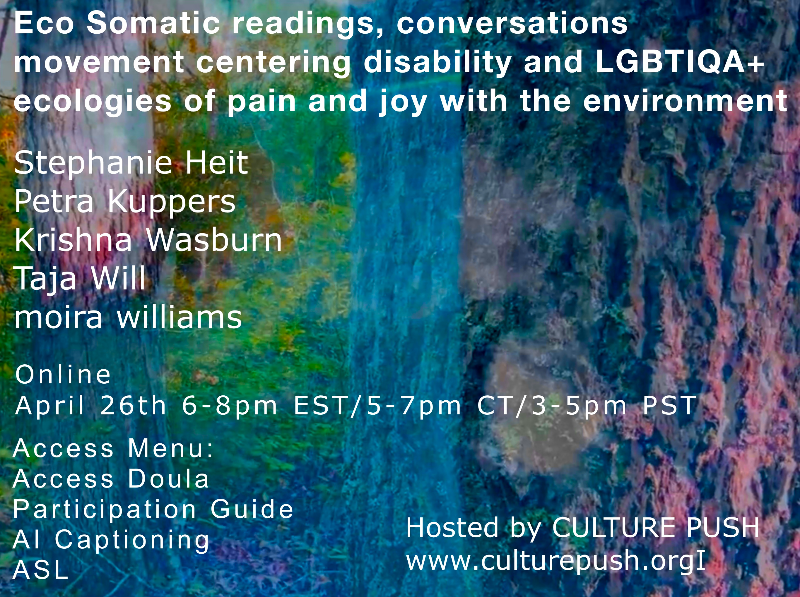
Eco Somatic readings, conversations and movement centering disability and LGBTIQA+ ecologies of pain and joy with the environment.

Featuring Stephanie Heit, Petra Kuppers, Krishna Washburn, Taja Will, and moira williams.

Where: Online Zoom Meeting

Zoom Registration link: Eco Somatic Registration April 26th

Access Menu:

  • Access Doula
  • Participation Guide
  • AI Captioning + ASL


Please contact moira670@gmail.com for more accessibility information requests and needs

Flyer Image Description: A tree filled image with a close up of two trees and their large textured bark. Between the two trees a hand from the forearm down and palm forward spreads its fingers. It looks like a ghost hand that is filled with the surrounding forest life. The entire background image is heavily saturated with almost neon reds, pinks, yellows, blues, greens and purples. On top of the glowing forest is white text saying: Eco Somatic readings and conversations: disability ecologies of pain and joy with the environment. Stephanie Heit, Petra Kuppers, Krishna Washburn, Taja Will, moira williams. Online April 26th 6-8pm EST/5-7pm CT/3-5pm PST. Access Menu: Access Doula, Participation Guide, AI Captioning.

Facilitators:

Stephanie Heit is a queer disabled poet, dancer, teacher, and co director of Turtle Disco, a somatic writing space on Anishinaabe land in Ypsilanti, Michigan. She is a Zoeglassia Fellow, and the author of PSYCH MURDERS (Wayne State University Press, 2022) and The Color She Gave Gravity (Operating System, 2017). Stephanie is an active member of the Olimpias; an international disability performance collective. She co-directed the Asylum Project (2015-2019); an experimental and community practice investigation into the many meanings of asylum. Stephanie is bipolar, a mad activist, and a shock/psych system survivor. Link to Stephanie’s website is HERE.

Petra Kuppers (she/her) is a disability culture activist, a wheelchair dancer, and a community performance artist. Petra grounds herself in disability culture methods. She uses eco somatics, performance, and speculative writing to engage audiences toward more socially just and enjoyable futures. She has been engaged in community dance and disability culture production since the late 80s. She continues to lead workshops internationally, in these forms as well as in disability-culture adapted social somatics. She is the Artistic Director of The Olimpias, an international disability culture collective, and co-creates Turtle Disco, a somatic writing studio, with her wife, poet and dancer Stephanie Heit, from their home in Ypsilanti, Michigan, on Three Fires Confederacy Territory, colonially known as Ypsilanti, Michigan. A link to Petra’s website is HERE.

Krishna Christine Washburn is artistic director and instructor for Dark Room Ballet, and co-directed the Telephone Film. She has an M.Ed. from Hunter College, BA from Barnard College, and is certified by the ACSM in biomechanics. She speaks regularly on self-audio description and educating blind/visually impaired dance students. A link to Krishna’s website is HERE.

Taja Will is a non-binary, chronically ill, queer, Latinx (Chilean) adoptee. They are a performer, choreographer, somatic therapist, consultant and Healing Justice practitioner based in Mni Sota Makoce, on the ancestral lands of the Dakota and Anishinaabe. Taja’s approach integrates improvisation, somatic modalities, text and vocals in contemporary performance. Their aesthetic is one of spontaneity, bold choice making, sonic and kinetic partnership and the ability to move in relationship to risk and intimacy. Will’s artistic work explores visceral connections to current socio-cultural realities through a blend of ritual, dense multi-layered worldbuilding and everyday magic. A link to Taja’s website is HERE.

moira williams is a disabled Indigenous artist, cross disability cultural activist/organizer and access doula; co-creating and weaving disability justice together with crip celebratory resistance and environmental justice. moira believes in access as art and “access intimacy” as an attitude needed to push beyond the limitations of the Americans with Disabilities Act. Their often co-creative work leads with disability, stemming from the understanding that deep-rooted cultural changes must be made in arts and environmental spaces and practices to become accessible. One part of affecting change is by placing disabled artists and activists in positions of influence to shape culture from within. Another part is acknowledging that entering positions of power is not the end goal. Instead, the end goal is to co-create an active culture where power positions no longer exist. moira’s on-going work with water focuses on access intimacy and water intimacy as ways forward to accessible waterways and joy. A link to moira’s website is HERE.

Categories
News / Announcements

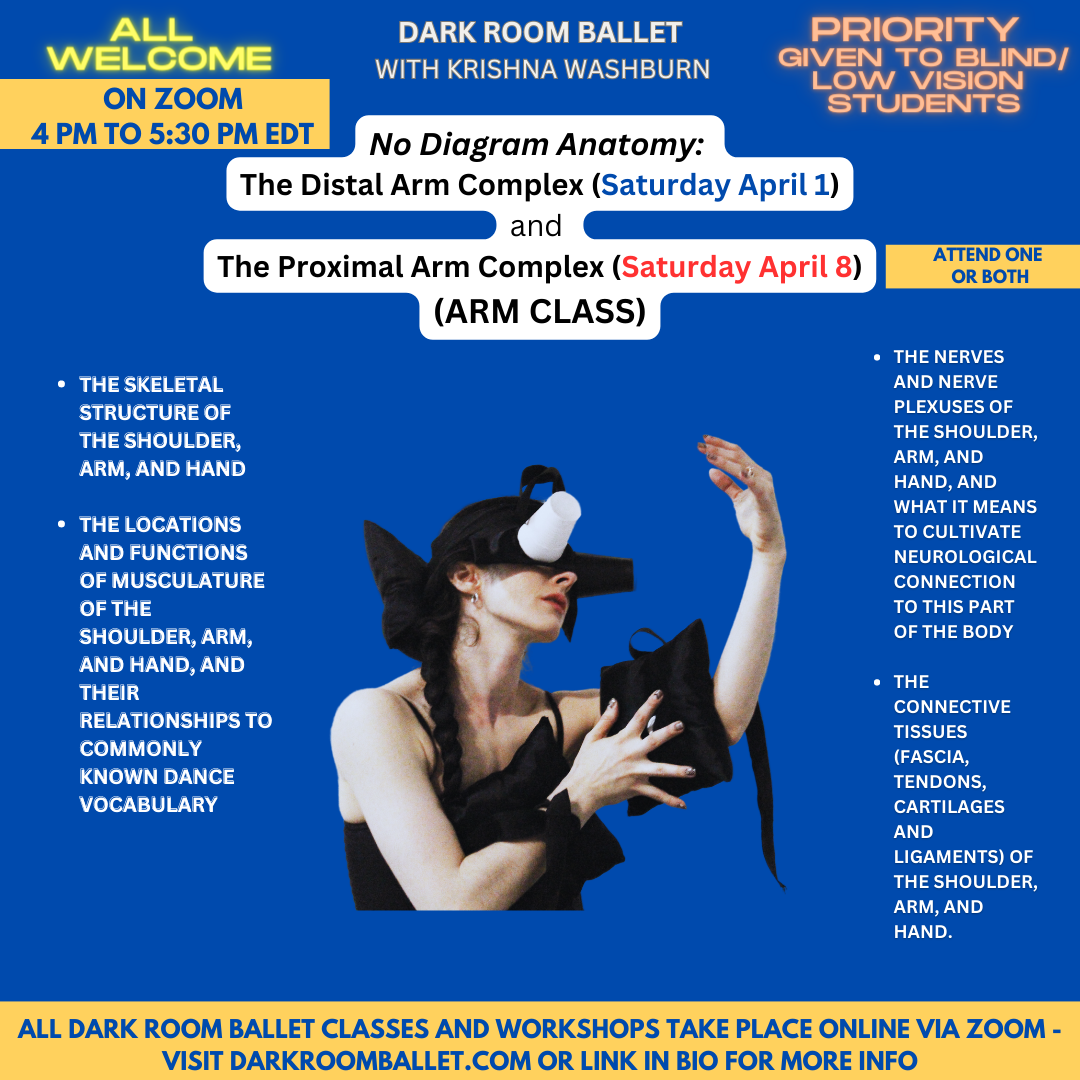
APRIL WORKSHOPS — No Diagram Anatomy: The Distal & Proximal Arm Complex (ARM CLASS)

Hosted by Movement Research, Dark Room Ballet anatomy workshops are designed specifically for the educational needs of blind and visually impaired adults (though all are welcome).

NOTE: This is a FREE class, but donations are welcomed.

No Diagram Anatomy for Dancers in the Dark Room:

➣ The Distal Arm Complex (April 1)

➣ The Proximal Arm Complex (April 8)

4 PM to 5:30 PM (Eastern / New York Time)
This workshop is offered online via Zoom – participants can attend ONE or BOTH sessions.


To register, please email: 
info@darkroomballet.com and let us know which sessions you would like to attend


Workshop Description

In this two-part workshop on the complete arm complex, we will use movement, touch, and conversation to not only cultivate scientific knowledge related to the shoulder, arm, and hand, but also initiate a higher degree of body awareness and neurological learning in this area. Evolutionary history and the marvels of human variation will also be addressed in this workshop.

No prior knowledge of human anatomy, dance, or self-audio description are required to participate, but all students will come away with deep anatomical knowledge, reduced movement anxiety, and tools to start learning how to talk about movement in a visceral way. Let’s get right down to the real nitty gritty!

Material covered in these two workshops will include:
  • The skeletal structure of the shoulder, arm, and hand
  • The locations and functions of musculature of the shoulder, arm, and hand, and their relationships to commonly known dance vocabulary
  • The nerves and nerve plexuses of the shoulder, arm, and hand, and what it means to cultivate neurological connection to this part of the body
  • The connective tissues (fascia, tendons, cartilages and ligaments) of the shoulder, arm, and hand.

All students will receive the complete script of the workshop two days beforehand, and the script can be reviewed either before or after the workshop. Although these two workshops are meant to be taken together, students are allowed to register for one or the other and they can both stand alone.

This workshop is designed for the educational needs of blind and visually impaired people and does not use diagrams.


About No Diagram Anatomy Workshop Series

No Diagram Anatomy workshops are in-depth dancer’s anatomy workshops that de-center sight and are designed for the educational needs of blind and visually impaired people. Participants will learn about their bodies’ layered anatomy from the outside-in using a combination of guided audio description, imagination, touch, and movement experimentation, and will also be given opportunities to practice talking about how the movement feels in the body (self-audio description).

Categories
News / Announcements

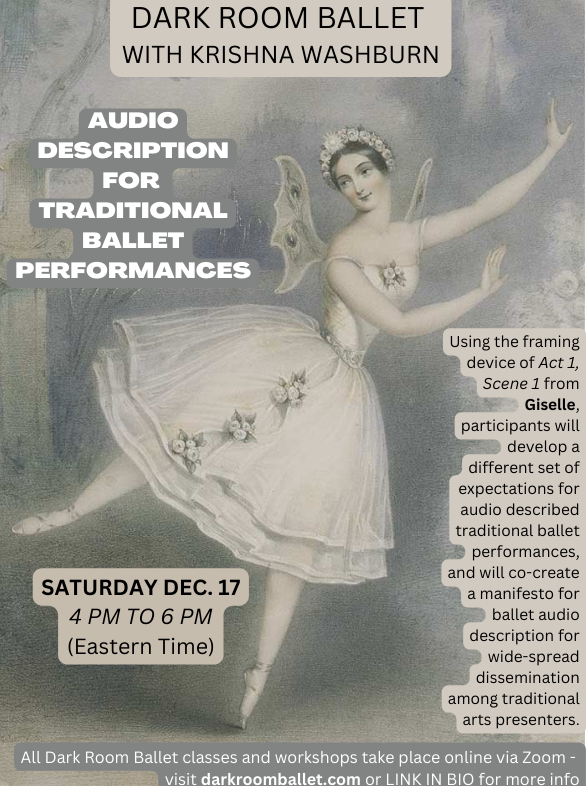
WORKSHOP: Audio Description for Traditional Ballet Performances (Saturday, December 17th)

Hosted by Movement ResearchDark Room Ballet is designed specifically for the educational needs of blind and visually impaired adults.

NOTE: This is a FREE class, but donations are welcomed.

Dark Room Ballet Presents:
Audio Description as an Art Form

Audio Description for Traditional Ballet Performances


Saturday, December 17th , 2022
4 PM to 6 PM (Eastern / New York Time)

NOTE: This is a 2 hour class

This workshop is offered online via Zoom


To register, please email: 
info@darkroomballet.com


Workshop Description

Using the framing device of Act 1, Scene 1 from Giselle, participants will develop a different set of expectations for audio described traditional ballet performances, and will co-create a manifesto for ballet audio description for wide-spread dissemination among traditional arts presenters.

Note: this is the last workshop in the Audio Description as an Art Form series, sponsored by Movement Research.

More audio description workshops are planned for 2023!

Categories
News / Announcements

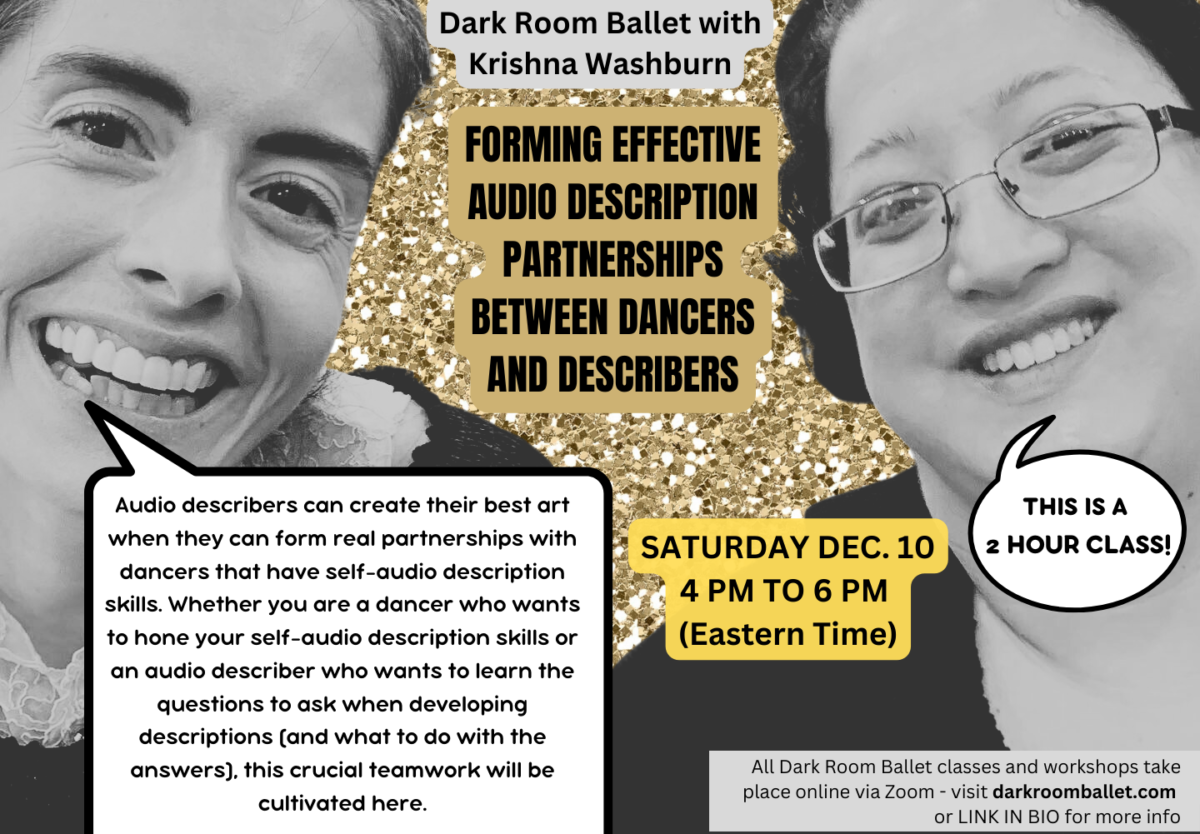
WORKSHOP: Forming Effective Audio Description Partnerships Between Dancers and Describers (Saturday, December 10th)

Hosted by Movement ResearchDark Room Ballet is designed specifically for the educational needs of blind and visually impaired adults.

NOTE: This is a FREE class, but donations are welcomed.

Dark Room Ballet Presents:
Audio Description as an Art Form

Forming Effective Audio Description Partnerships Between Dancers and Describers


Saturday, December 10th , 2022
4 PM to 6 PM (Eastern / New York Time)

NOTE: This is a 2 hour class

This workshop is offered online via Zoom


To register, please email: 
info@darkroomballet.com


Workshop Description

Audio describers can create their best art when they can form real partnerships with dancers that have self-audio description skills. Whether you are a dancer who wants to hone your self-audio description skills or an audio describer who wants to learn the questions to ask when developing descriptions (and what to do with the answers), this crucial teamwork will be cultivated here.

Note: this is the second to last workshop in the Audio Description as an Art Form series, sponsored by Movement Research

Categories
News / Announcements

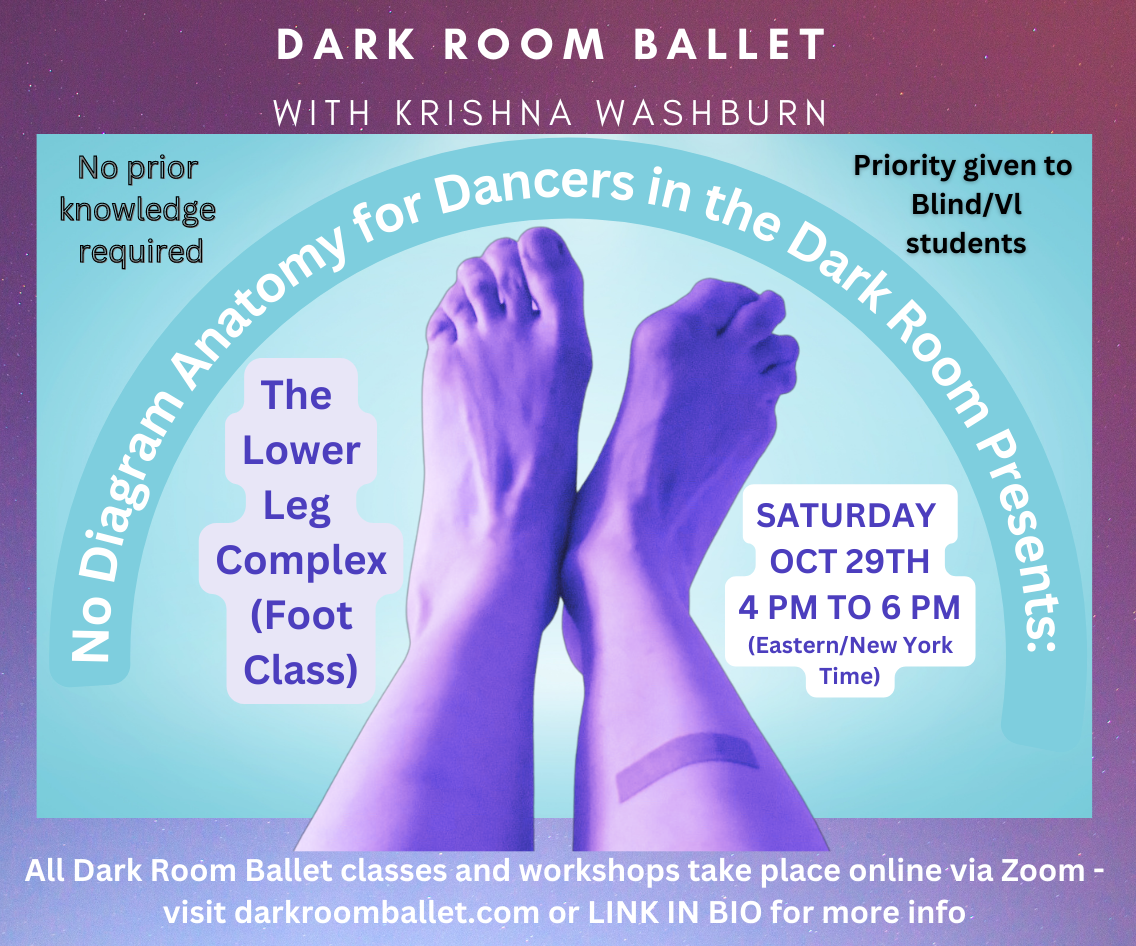
WORKSHOP: No Diagram Anatomy for Dancers in the Dark Room Presents: The Lower Leg Complex (Foot Class) – Saturday, October 29th

Hosted by Movement ResearchDark Room Ballet is designed specifically for the educational needs of blind and visually impaired adults.

NOTE: This is a FREE class, but donations are welcomed.

No Diagram Anatomy for Dancers in the Dark Room Presents:

The Lower Leg Complex (Foot Class)


Saturday, October 29th , 2022
4 PM to 6 PM (Eastern / New York Time)

NOTE: This is a 2 hour class

This workshop is offered online via Zoom


To register, please email: 
info@darkroomballet.com


Workshop Description

The third and final in a series of three highly detailed workshops analyzing specific anatomical areas in detail. In this workshop, we will use movement, touch, and conversation to not only cultivate scientific knowledge related to the lower leg complex (the foot and related structures!), but also initiate a higher degree of body awareness and neurological learning in this area. Evolutionary history and the marvels of human variation will also be addressed in this workshop. No prior knowledge of human anatomy, dance, or self-audio description are required to participate, but all students will come away with deep anatomical knowledge, reduced movement anxiety, and tools to start learning how to talk about movement in a visceral way. Let’s get right down to the real nitty gritty!

Material covered in this workshop will include:

  • The skeletal structure of the lower leg, ankle, and foot
  • The locations and functions of musculature of the lower leg, ankle, and foot, and their relationships to commonly known dance vocabulary
  • The nerves and nerve plexuses of the lower leg, ankle, and foot, and what it means to cultivate neurological connection to this part of the body
  • The connective tissues (fascia, tendons, cartilages and ligaments) of the lower leg, ankle and foot.

All students will receive the complete script of the workshop two days beforehand, and the script can be reviewed either before or after the workshop.

This workshop is designed for the educational needs of blind and visually impaired people and does not use diagrams.

Categories
News / Announcements

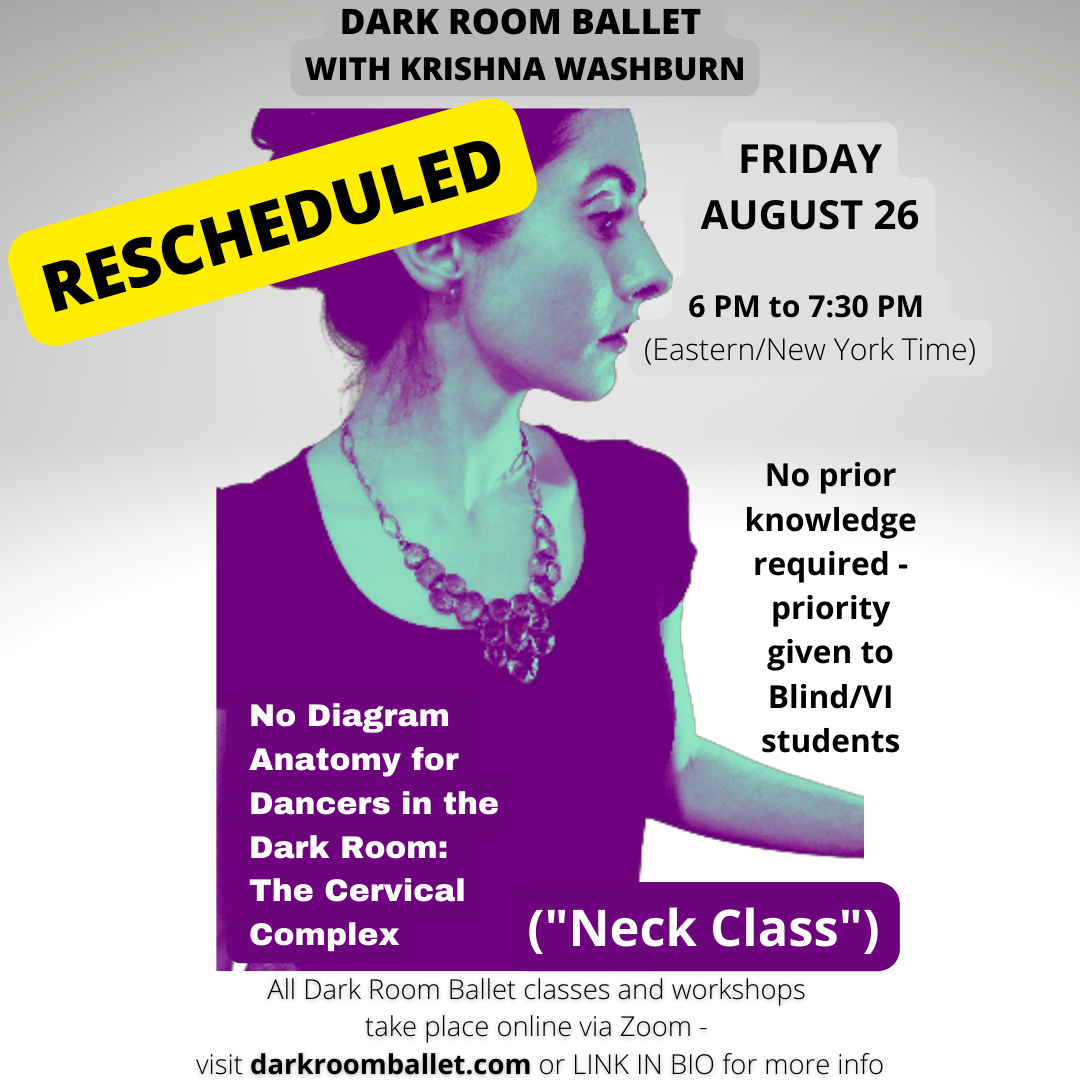
WORKSHOP RESCHEDULED: No Diagram Anatomy for Dancers in the Dark Room: The Cervical Complex (Neck Class) – Friday, August 26th

Hosted by Movement Research, Dark Room Ballet is designed specifically for the educational needs of blind and visually impaired adults.

Note: This is a FREE class, but donations are welcomed.

No Diagram Anatomy for Dancers in the Dark Room presents:

Anatomy in Detail:
The Cervical Complex (Neck Class)

NEW DATE & TIME!

FRIDAY, August 26th, 2022
6:00 PM to 7:30 PM (Eastern/New York Time)


This workshop is offered online via Zoom


To register, please email: 
info@darkroomballet.com


Workshop Description


The second in a series of three highly detailed workshops analyzing specific anatomical areas in detail. In this workshop, we will use movement, touch, and conversation to not only cultivate scientific knowledge related to the cervical complex (the neck!), but also initiate a higher degree of body awareness and neurological learning in this area. Evolutionary history and the marvels of human variation will also be addressed in this workshop. No prior knowledge of human anatomy, dance, or self-audio description are required to participate, but all students will come away with deep anatomical knowledge, reduced movement anxiety, and tools to start learning how to talk about movement in a visceral way. Let’s get right down to the real nitty gritty!

Material covered in this workshop will include:

  1. The cervical spine, the hyoid bone, and neighboring related skeletal features
  2. The layered musculature of the front, sides, and back of the neck
  3. The cervical spinal cord, nerves and nerve plexuses of the neck
  4. Organ systems of the neck (respiratory, digestive, endocrine)

All students will receive the complete script of the workshop two days beforehand, and the script can be reviewed either before or after the workshop. This workshop is designed for the educational needs of blind and visually impaired people and does not use diagrams.


About No Diagram Anatomy Workshop Series


No Diagram Anatomy workshops are in-depth dancer’s anatomy workshops that de-center sight and are designed for the educational needs of blind and visually impaired people. Participants will learn about their bodies’ layered anatomy from the outside-in using a combination of guided audio description, imagination, touch, and movement experimentation, and will also be given opportunities to practice talking about how the movement feels in the body (self-audio description).

For 2022, the theme for No Diagram Anatomy has been Nitty Gritty, in which a single anatomical region is demystified and explained in depth. These three workshops are:

  • The Gluteus Complex (Butt Class) (June 11, 2022)
  • The Cervical Complex (Neck Class) (Rescheduled to August 26, 2022)
  • The Lower Leg Complex (Foot Class) – (October 29, 2022)
Categories
News / Announcements

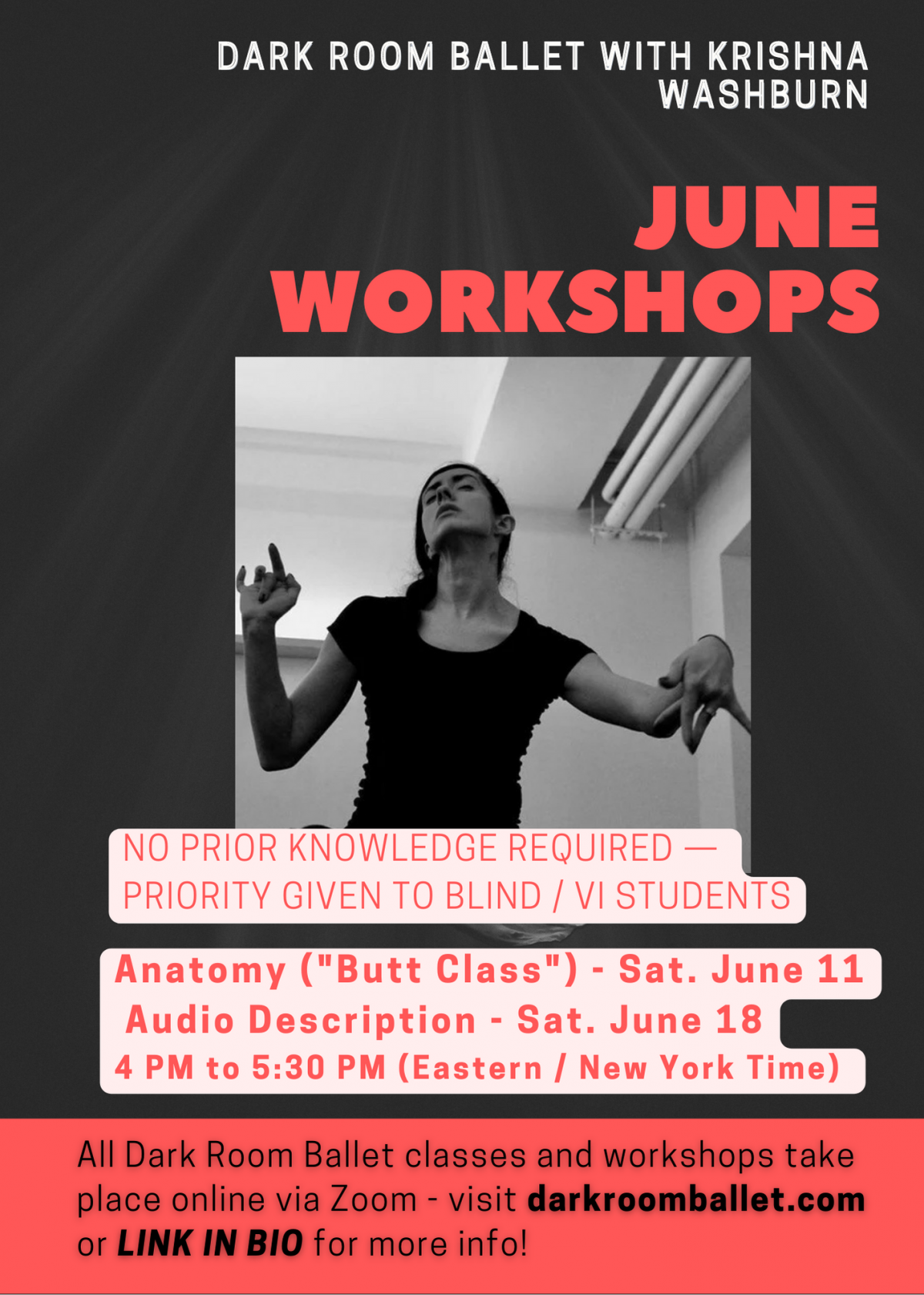
JUNE WORKSHOPS: Anatomy and Audio Description

Announcing two upcoming workshops open to all (priority given to blind and visually impaired students), no prior experience required.

Both workshops take place online via Zoom.

To register for one or both workshops, please write to info@darkroomballet.com as soon as possible to complete the intake process.

Saturday, June 11, 2022

4:00 PM to 5:30 PM (Eastern Time)

No Diagram Anatomy for Dancers in the Dark Room Presents Anatomy in Detail: The Gluteus Complex (Butt Class) 

(link to Movement Research class listing)

The first in a series of three highly detailed workshops analyzing specific anatomical areas in detail. In this workshop, we will use movement and conversation to not only cultivate scientific knowledge related to the gluteus complex (the butt!), but also initiate a higher degree of body awareness and neurological learning in this area. Evolutionary history and the marvels of human variation will also be addressed in this workshop. No prior knowledge of human anatomy, dance, or self-audio description are required to participate, but all students will come away with deep anatomical knowledge, reduced movement anxiety, and tools to start learning how to talk about movement in a visceral way. Yes, we’ll be laughing, too.

Part One: Superficial muscles

Part Two: Intermedial muscles

Part Three: Deep muscles

Part Four: Bone

Part Five: Nerves and patterns of motor neuron response


Saturday, June 18, 2022

4:00 PM to 5:30 PM (Eastern Time)

Voices from the Dark Room: The Multitude of Audio Descriptions and When to Touch Them 

(link to Movement Research class listing)

This self-audio description workshop gives students the framework for thinking of audio description as not a singular process with a singular best practice, but as multiple art forms with multiple purposes. Audio description has, for too long, been considered as an access tool that can be deployed at a moment’s notice with little forethought, but this sort of thinking creates environments of severe inequity. Classrooms, rehearsals, and performances where blind and visually impaired people are given inadequate connection to the art at their center are ableist places.

Part One: Audio Description in Technique Class

Part Two: Audio Description for Narrative Performance (story arc)

Part Three: Audio Description for Non-Linear Performance (emotional quality)

Part Four: Audio Description as Cooperative Creation and Collaboration (two voices)

Part Five: Audio Description for the Ensemble (a thousand voices)

Categories
News / Announcements

COMING SOON: No Diagram Anatomy for Dancers in the Dark Room (March 19 and March 26)

Sponsored by Movement Research, these two workshops are a continuation of and makeup dates for workshops held last year in the anatomy series.

Like all current Dark Room Ballet classes, these workshops:

  • Will take place virtually using Zoom
  • Prioritize the educational needs of blind and visually impaired adults
  • Are free, especially for blind and visually impaired students
  • Are taught by Krishna Washburn, a blind professional dancer and dance teacher

Workshop dates:

  • The Complete Lower Body: from the soles of the feet to pelvis — Saturday, March 19 from 4:00 PM to 5:30 PM (Eastern / New York Time)
    The Complete Upper Body: from the fingertips to the crown — Saturday, March 26 from 4:00 PM to 5:30 PM (Eastern / New York Time)

You can participate in either or both workshops.

Our instructor Krishna says of the workshops:

These two workshops are meant to help participants cultivate deep levels of body awareness, to get to know and appreciate the unique features of their own anatomy, and to feel movement in a highly specific way that can then be described verbally (self-audio description). These workshops are an invitation to disabled dancers, especially blind and visually impaired dancers, who may have been denied important information about their own bodies, or who have been discouraged from trusting their own physical perceptions, to find certainty, confidence, and joy in movement. 

These two workshops are not fine-grain scientific anatomical analysis, but workshops that do deep dives regarding sensing highly specific anatomy on more targeted regions of the body will be coming up later this year (June: Pelvis, August: Foot, November: Neck)

To register:

Please write to: info@darkrooomballet.com

Please let us know which workshop you would like to attend…

If you are not blind or visually impaired, please let us know why you would like to attend these workshops…

If you are a current or returning Dark Room Ballet student who has already registered, you don’t have to write, but you can if you want to!

Please note:

These workshops are separate from Dark Room Ballet Introductory Level ballet classes for blind and visually impaired adults (which begin again on Saturday, April 9th) and Dark Room Ballet Open Level classes, which are ongoing and open for registration; please let us know if you are interested in either class so we can learn more about you as a potential new student.

Categories
News / Announcements

WORKSHOP: Self Audio-Description and the Motor Neuron: Learning How to Play Your Own Instrument, Wed. February 16th from 6 PM to 7 PM (Eastern Time)

Krishna Washburn of Dark Room Ballet will be sharing one of her popular anatomy and audio description workshops, this time sponsored by Hook & Loop out of Philadelphia (not Movement Research in NYC).

The Dark Room Ballet community and friends are invited — if you have participated in a version of this workshop before, please feel free to join again!

The workshop is free and will take place online; you must register directly with Hook & Loop to receive the Zoom information and recording after the event.

Description and RSVP link below.

Self Audio-Description and the Motor Neuron: Learning How to Play Your Own Instrument

Wednesday February 16th, 2022

6:00 PM to 7:00 PM, Eastern Time


Facilitated by Krishna Washburn
Closed Captioning available

This workshop helps people to begin developing a self-audio description practice, in order to create movement art that connects with others on a visceral level. This workshop de-centers and de-prioritizes sight, and is appropriate for movers and dancers of all levels of experience or inexperience. Learn how to understand how movement feels in your body, and then practice talking about those feelings with others while also learning about the wonders of human anatomy.

By RSVP-ing you will receive the zoom link, full access information and a recording for this workshop. Recordings will be sent out by early March via Hook & Loop.

Please fill out this form to RSVP: Self Audio-Description and the Motor Neuron: Learning How to Play Your Own Instrument

Please send email to hookandloopphl@gmail.com with any questions.